Garage Door Cables Are Worn and Need Replacing
The clearest signs your garage door cables are worn and need replacing include visible fraying or loose wire strands, slack or sagging cables hanging off the drum, uneven door movement, loud grinding or snapping sounds during operation, a door that slams shut too fast, and visible rust or corrosion along the cable surface. Any one of these signs means the cable is approaching failure and needs professional attention before the door becomes a safety hazard.
Most homeowners think about their garage door springs, their opener motor, their remote batteries. Nobody thinks about the cables until one snaps and the door drops. By then, the warning signs had been there for weeks, sometimes months.
Garage door cables are the unsung workhorses of the entire system. They connect the bottom of the door to the spring mechanism, transfer the lifting force, and keep every panel moving in a straight, balanced line. When they start wearing out, the whole system pays the price.
Here is what to look for before it gets to that point.
What Do Garage Door Cables Actually Do?
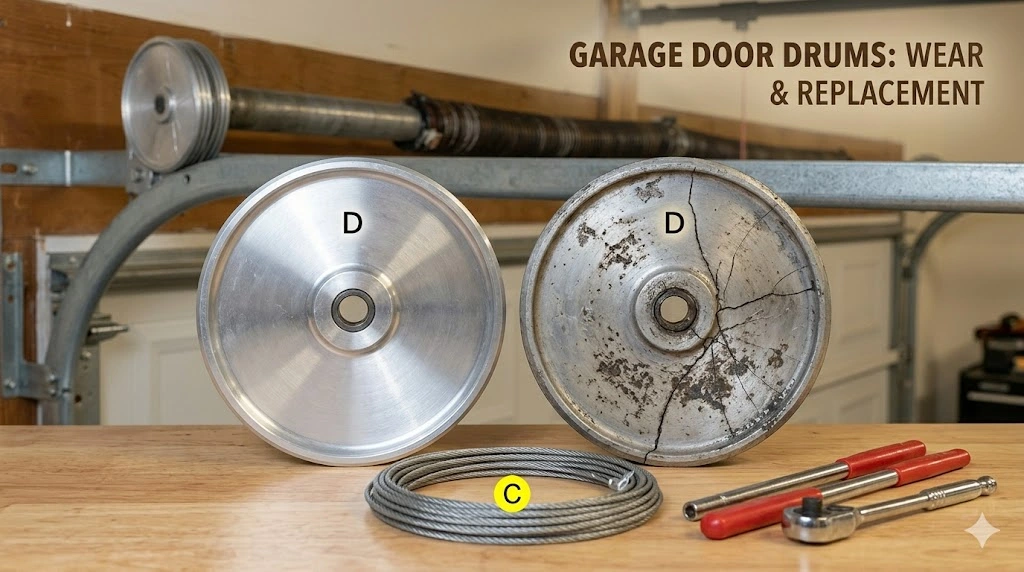
Before jumping into the warning signs, it helps to understand what cables are responsible for. Garage door lift cables run from the bottom bracket on each side of the door, up and over the cable drums, and connect to the counterbalance spring system at the top.
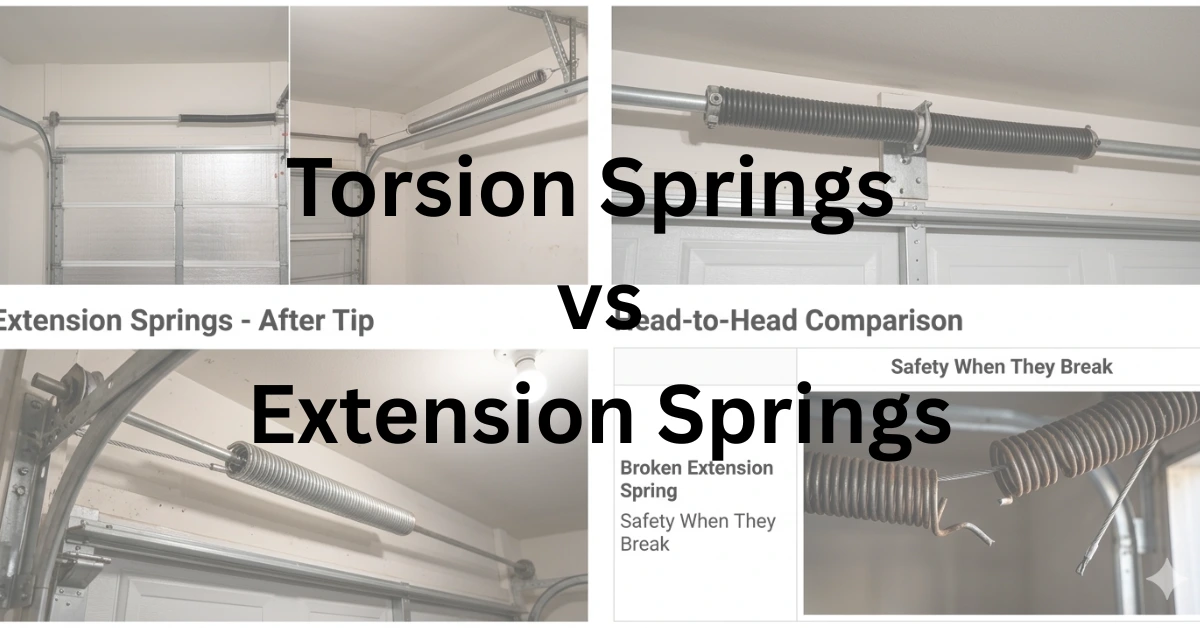
Every time the door opens or closes, these cables are under enormous tension. They are the mechanical link between the spring’s stored energy and the door’s actual movement. On a torsion spring system, the cables wrap around drums mounted on the torsion shaft. On an extension spring system, the cables run through pulleys and work alongside safety cables inside the springs.
In both setups, the cables are working under high load, every single cycle, for years. That wear adds up.
Sign 1: Visible Fraying or Loose Wire Strands
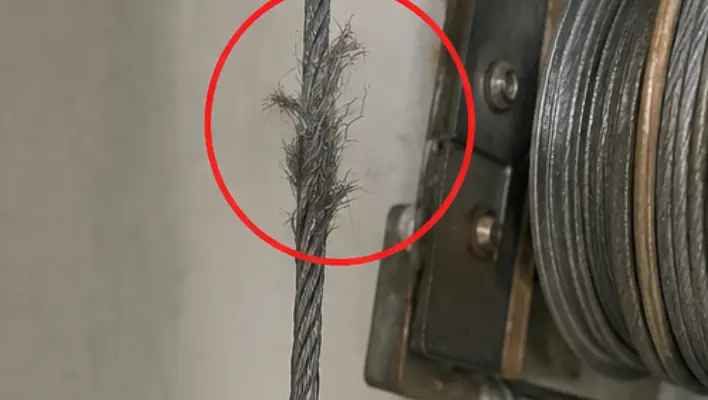
This is the most direct warning you will ever get, and most people walk right past it.
Garage door cables are made of multiple steel wire strands wound tightly together into a single, smooth cable. When the cable starts to fail, individual strands begin to break and poke outward. The cable starts to look “fuzzy” or hairy near the drum or bottom bracket. In more advanced cases, you can see actual broken wires sticking out at angles.
A cable does not fray all at once. It unravels one strand at a time, and every broken strand transfers its load to the remaining wires, accelerating the failure of everything left.
If you can see even a few loose strands, the cable has already lost a meaningful percentage of its load-bearing capacity. It is not a “keep an eye on it” situation. It is a replacement for the current situation.
Pro Tip: Check your cables at the point where they wrap around the cable drum and where they attach to the bottom bracket. These are the two highest-stress points and where fraying almost always starts first. You do not need any tools, just a flashlight and thirty seconds during your next oil change or garbage run. Catching fraying at two or three strands is a simple cable swap. Waiting until ten strands are gone often means damaged drums, bent brackets, and a much bigger repair bill.
Sign 2: Slack or Sagging Cables
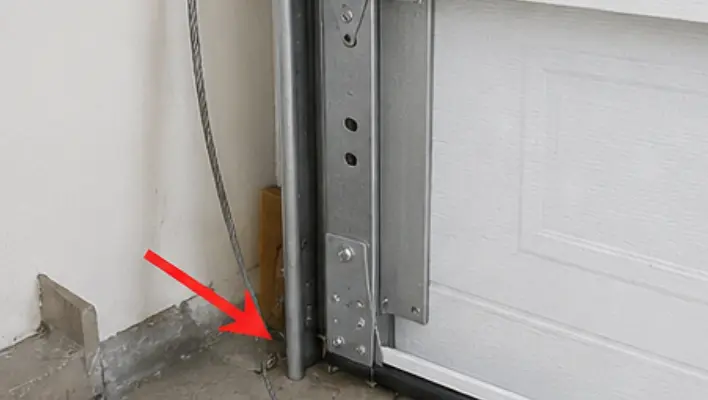
Pull your car out, stand in front of your garage, and look at both cables running up the sides of the door.
They should be taut. Tight. Running in a clean, straight line from the bottom bracket up to the cable drum with no visible looseness.
If one cable looks like it is drooping, hanging off to the side, or coiled on the floor near the bottom of the door, it has either snapped, unwound from the drum, or lost its tension completely. A slack cable means that side of the door has lost its counterbalance support and is now putting the full dead weight load on the other cable, the spring, and the opener motor.
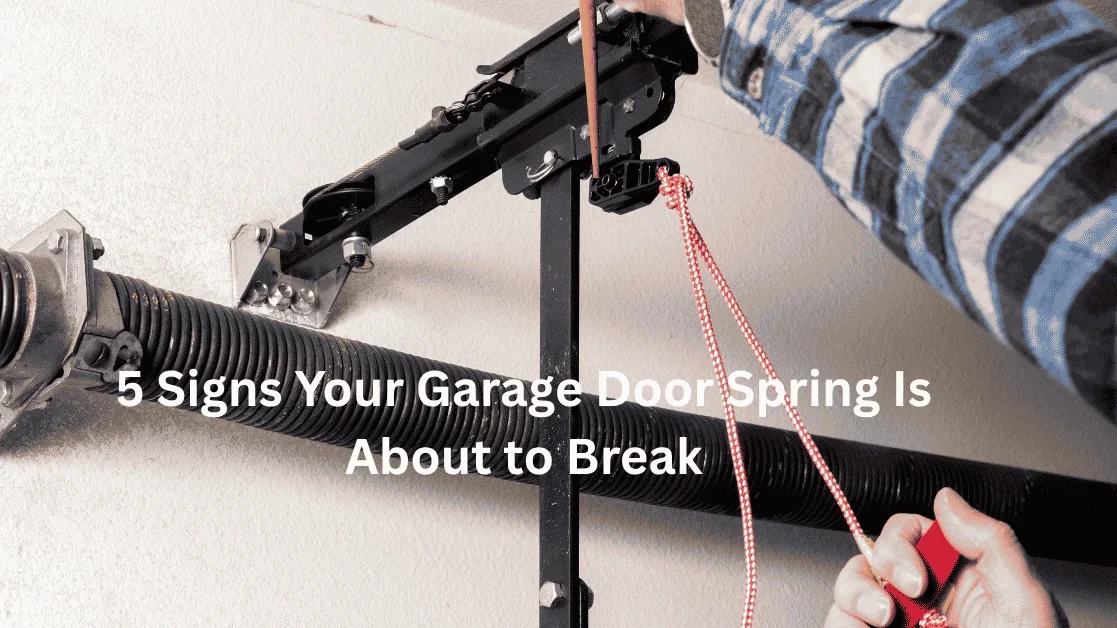
This is also one of the most misdiagnosed problems in garage door repair. Many homeowners see a slack cable and assume the spring broke. Sometimes the spring is fine and the cable simply slipped off the drum. Other times, a broken spring is exactly what caused the cable to go slack, which is why we covered the relationship between springs and cables in detail in our guide on 5 signs your garage door spring is about to break.
Pro Tip: Never try to wind a slack cable back onto the drum yourself. The cable drum is connected to the torsion shaft, which is under spring tension. If you grab the cable and try to guide it by hand while the spring is still wound, you are one slip away from serious injury. Stop using the door, disconnect the opener, and call a technician.
Sign 3: The Door Moves Unevenly or Looks Crooked
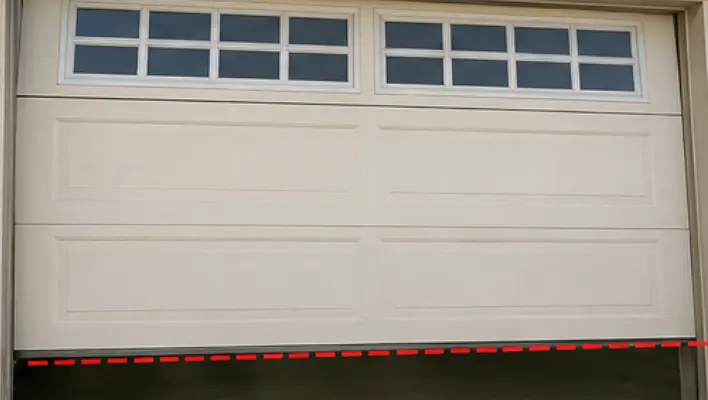
Your garage door should rise and lower as one flat, level panel. Both sides should travel at exactly the same speed, maintaining a consistent horizontal line from left to right throughout the entire movement.
If the door looks tilted during operation, if one corner rises faster than the other, or if it appears to hang lower on one side when closed, a cable is almost certainly the cause. Each cable controls one side of the door independently. When one weakens, stretches, or partially breaks, it loses its ability to carry its share of the load, and the door drifts toward the weaker side.
Running the door repeatedly in this condition puts extreme side stress on the tracks, forces the rollers into unnatural angles, and can cause the top panel to bend as the opener tries to drag a lopsided door upward. What starts as a cable issue becomes a track and panel problem very quickly.
If this sounds familiar, you should know why your garage door gets stuck halfway, because an uneven cable load is one of the most common causes of a door that stops mid-travel.
Pro Tip: Do a quick visual test while someone else operates the door from a safe distance. Watch the bottom edge of the door as it rises. It should stay level the entire way up. If you see more than a half-inch of height difference between the left and right sides, stop using the door and have a technician inspect both cables and the cable drums before the imbalance causes track damage.
Sign 4: Grinding, Snapping, or Popping Sounds
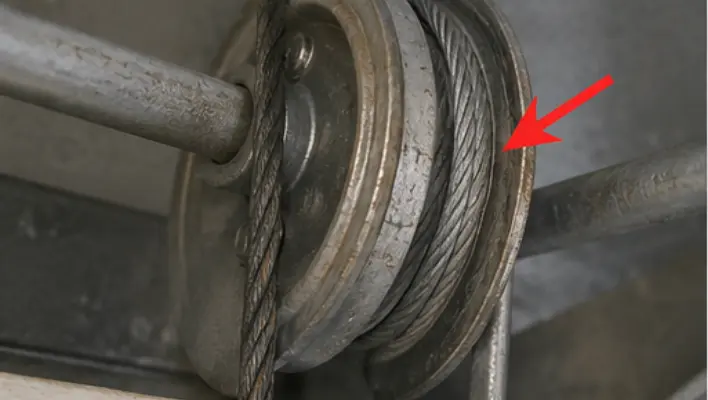
A healthy garage door is not silent, but it has a consistent sound. You know what your door normally sounds like. When cables start to wear, the sound changes in a very specific way.
Fraying cable strands rubbing against the drum surface create a grinding or grating noise. A cable that has partially slipped off the drum creates a rhythmic clunking or thumping with each rotation. A cable that snaps completely makes a sharp, sudden crack that sounds similar to a gunshot, much like a spring break, though typically slightly less explosive.
The grinding and thumping sounds are the early warning stage. The crack means the cable is already gone.
Friction-based noises are especially common in Sunrise, FL because the combination of heat and humidity accelerates surface oxidation on steel cables. As the cable surface roughens from corrosion, it creates more friction against the drum and pulley, and that friction accelerates fraying even further.
Pro Tip: Do not confuse cable noise with opener noise. Opener grinding usually stays consistent and comes from the motor housing. Cable grinding changes pitch or intensity depending on where the door is in its travel, usually louder near the top or bottom of the stroke where drum wrapping tension is highest. If the sound is position-dependent, suspect the cable first.
Sign 5: The Door Drops Too Fast or Slams Shut
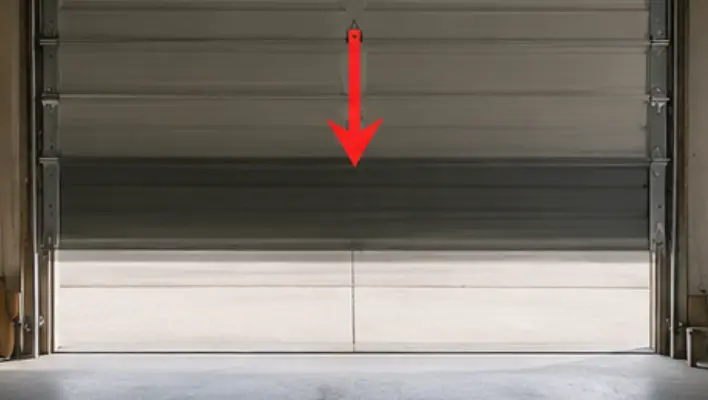
This one is a safety emergency, not just a warning sign.
Garage door cables are responsible for controlling the rate at which the door descends. The counterbalance spring does the heavy lifting on the way up, but on the way down, the cables apply resistance to prevent the door from free-falling under its own weight. When cable tension drops below the necessary level, the door descends faster than it should.
In mild cases, the door just closes with more force than usual. In severe cases, it slams shut hard enough to bounce off the ground. A 200-pound door slamming shut at free-fall speed is capable of crushing anything underneath it, including a car hood, a foot, or a pet.
This is not a “watch and wait” scenario. A door that is closing too fast needs same-day attention from a professional. If the door is already doing this, do not use it manually and disconnect the automatic opener until the cables are replaced.
Pro Tip: Here is a simple slam test you can do safely. With the door fully open and the opener disconnected, lower the door manually from about waist height and let go. It should descend slowly and stop on its own, or come to a gentle rest at the bottom. If it accelerates and hits the ground with force, the cable tension is insufficient. This test takes ten seconds and could prevent a serious injury.
Sign 6: Visible Rust or Corrosion on the Cable Surface
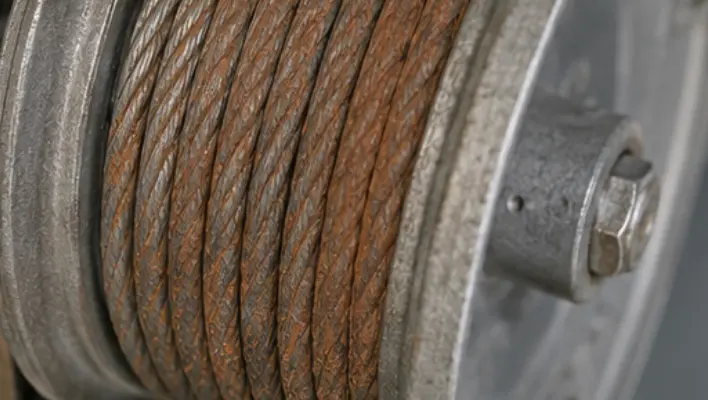
Steel cables and Florida humidity are not friends.
A healthy cable should look uniformly gray and smooth, with tight, clean winding visible along its length. A cable developing surface rust looks orange or brown, feels rough to the touch, and often has a slightly flattened or irregular cross-section where the corrosion has etched into the outer wire strands.
Rust does not just look bad. It actively weakens the steel, increases the surface friction against drums and pulleys, and makes the outer strands brittle and prone to snapping. A cable that has developed significant rust along its length has lost some of its original tensile strength, even if no strands are visibly broken yet.
In Sunrise, moisture collects at the bottom bracket connection point and at the cable drum area where the cable coils tightly. These are the two most common rust starting points. Check them specifically.
Pro Tip: Light surface discoloration is normal on older cables and is not an emergency on its own. The threshold for immediate concern is rust that has progressed into pitting, where you can see actual divots or roughness along the wire surface, or rust that has caused the outer strands to look flattened or corroded through. Routine lubrication of the springs, pulleys, and hinges as part of a scheduled garage door maintenance service significantly slows cable rust by reducing moisture accumulation in the system.
What Happens If You Ignore Worn Cables?
The failure path for worn cables is predictable and it gets expensive fast.
A frayed cable that snaps under load drops its side of the door instantly. The full weight transfers to the opposite cable, which may also snap. The door falls, hits the ground, and the impact can crack panels, destroy the bottom seal, bend the tracks, and damage whatever is below it at the time.
Beyond the door itself, a cable failure under load puts a sudden shock force through the spring system. Torsion springs that take an unexpected full-load spike can break at that moment even if they have cycles remaining. What started as a $150 cable replacement can turn into a $400 combined cable and spring job, plus panel and track repairs on top.
The garage door repair service cost for catching a worn cable early is a fraction of what emergency repair costs after a full failure.
Can You Replace Garage Door Cables Yourself?
The short answer is that you should not.
Cables are connected directly to the spring system, and any adjustment to cable tension affects the spring’s mechanical balance. On torsion spring systems, the cable drum sits on the same shaft as the wound torsion spring. Removing or re-attaching a cable requires either releasing the spring tension first or working around a fully wound spring, both of which require winding bars, proper clamping, and hands-on training.
Even on extension spring systems, which appear simpler, the cable routing through pulleys and the spring’s stored stretch energy create real risk for anyone without professional experience.
If your cables need replacing, a professional technician can also inspect the cable drums, bottom brackets, pulleys, and the spring system condition in the same visit. Cables rarely fail in isolation. When a cable is worn, the components it touches are usually showing wear too. A proper garage door spring replacement or cable job done professionally includes a full system check that catches secondary issues before they become the next emergency.
The Bottom Line
Garage door cables do not announce their failure with flashing lights. They give quiet, visual warnings first, fraying strands, a little sag, some surface rust, a slightly uneven door. Then they give audible warnings, grinding, snapping, unusual sounds during operation. If those go ignored, the final warning is a door that slams, drops, or stops working entirely.
The gap between the first warning sign and a full cable failure is usually weeks to a few months. That is more than enough time to schedule a quick inspection and handle it cleanly, at a fraction of the cost of emergency repairs.
If you noticed any of these signs today, do not put it off until tomorrow.